






Building for Greater Resilience: Why Impact-Resistant Roofing Matters More Than Ever

Resilience Starts at the Top
The way we build our homes is evolving in response to the conditions they must withstand. In some regions of Canada, hail, high winds, and other severe weather events are raising new questions about the durability of the building envelope.
The issue is no longer simply how to repair homes after a weather event, but rather: How can homes be better prepared, from the moment they are built, for the conditions of tomorrow?
Building with Resilience in Mind
A resilient home is designed to better withstand the conditions to which it may be exposed.
This approach begins long before repairs are required. It involves considering material performance from the design stage and identifying the building components that are most exposed.
The roof is clearly one of them.
Why Is Roof Resilience Becoming Increasingly Important?
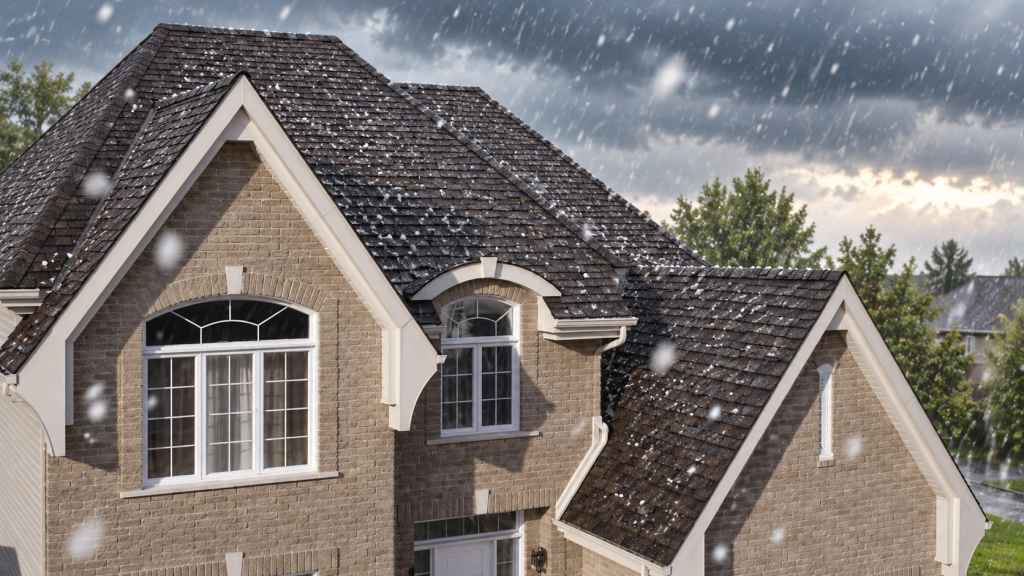
Positioned directly between the home and the elements, the roof is particularly exposed to hail, wind, and severe weather.
In regions that regularly experience hailstorms, the ability of roofing materials to withstand impacts should therefore be considered from the construction stage.
Alberta is a strong example. The province has experienced at least one major hailstorm every year over the past two decades, resulting in more than $11 billion in insured damage.
Beyond insured losses, these events can also cause significant disruption for families, including repair delays and unexpected expenses. This reality reinforces the value of more preventive approaches designed to better prepare homes before damage occurs.
Class 4: What Does It Mean?

This is where the UL 2218 Class 4 rating comes into play.
This classification is used to evaluate the impact resistance of roofing materials. Class 4 is the highest rate within this classification, making it a useful indicator when looking for a roofing solution designed to provide enhanced impact resistance.
Vangard shingles from BP Canada support this approach. Rated UL 2218 Class 4 and manufactured with SBS-modified asphalt, they provide a solution suited to projects where enhanced impact resistance is a priority.
The goal is not to make a roof invulnerable, but to better adapt materials to the risks the building may face.
What If Resilience Became the Standard?
This is where the conversation extends beyond the choice of a single product. Historically, building design has been guided by criteria such as cost, aesthetics, and energy efficiency. Today, resilience is gradually becoming a more important part of that discussion.
For building professionals, the challenge is to design homes that are better prepared for current and future conditions, while helping reduce damage, repairs, and disruption for occupants.
What if impact-resistant roofing became the standard rather than an option?
Homes by Avi already provides a concrete example of this approach. The builder has chosen to include BP Canada’s Class 4 Vangard shingles as a standard feature on its new single-family homes in Alberta.
Learn more about the Homes by Avi and BP Canada initiative here.
This decision reflects an important shift: moving beyond simply responding to damage and incorporating resilience into construction decisions from the outset.
Building Today with Tomorrow in Mind
The roof is only one component of a resilient home. However, it demonstrates how material choices can contribute to a more proactive approach to construction.
For builders, architects, and other industry professionals, this raises a broader question: Which decisions made today will help create homes that are better prepared for tomorrow’s conditions?
The adoption of impact-resistant solutions may well be part of this evolution.
Could today’s optional solutions become tomorrow’s construction standards?
Resilience starts at the top.